
 +1 555 346 27 41


Most luxury real estate investment mistakes in Tanzania happen before the buyer ever sees a title document: a deposit is paid on a beachfront villa because the photographs, the price and the developer’s confidence felt right. Foreign buyers in Zanzibar and Dar es Salaam are not buying freehold land, and the legal route, the lease term and the approvals behind each property differ from one transaction to the next. This guide explains the five most consequential and preventable mistakes, and the evidence you should collect before any money moves.
The five common luxury real estate investment mistakes in Tanzania are misunderstanding foreign ownership rights, skipping independent legal checks, trusting unrealistic rental projections, overlooking property costs and infrastructure, and failing to plan for resale. Investors should verify land rights, approvals, lease conditions, operating expenses and exit restrictions before paying a deposit, particularly in Zanzibar.
The five mistakes, in the order this guide covers them:
- Misunderstanding foreign property ownership — assuming a foreigner can hold land outright, or that mainland and Zanzibar rules are the same.
- Skipping independent property due diligence — relying on the seller, the agent or a brochure instead of official records and an independently instructed lawyer.
- Trusting rental yield projections — accepting gross figures that ignore occupancy, commissions, staffing and maintenance.
- Underestimating ownership costs — overlooking ground rent, taxes, coastal maintenance, water, power and capital replacement.
- Buying without an exit strategy — ignoring remaining lease years, transfer consents and the narrow pool of luxury resale buyers.

Why Luxury Real Estate Investors Make Costly Mistakes in Tanzania
Readers who reach this stage are usually past the dreaming phase. You may have a shortlist of villas in Nungwi or Paje, a brochure for an off-plan development near Fumba, or an apartment offer in Masaki. The question is no longer whether Tanzania is attractive, but whether a specific property gives you a lawful, documented and transferable right that justifies the price.
The word “luxury” describes the finish, the location and the service level of a property; it does not reduce the legal restrictions that apply to a foreign buyer. An infinity pool, imported stone and a hotel-style management contract sit on exactly the same land law as a modest bungalow. From our experience on the island, the more polished the marketing, the more tempting it becomes to treat paperwork as a formality.
The United Republic of Tanzania also contains two distinct property systems. Mainland Tanzania, including Dar es Salaam, applies the Land Act, 1999 and its investment framework under the Tanzania Investment and Special Economic Zones Authority (TISEZA). Zanzibar applies its own Land Tenure Act, 1992, its own investment law administered by the Zanzibar Investment Promotion Authority (ZIPA), and its own land registry and tax authority. A structure that works for a Zanzibar villa cannot automatically be copied for a Dar es Salaam apartment, and the reverse is equally true.
The five mistakes in this guide overlap. Off-plan purchases magnify mistakes 2, 3 and 5, because the asset does not yet exist. Coastal locations magnify mistakes 1, 4 and 5, because shoreline rights, environmental approvals and erosion exposure affect both value and legality. We have therefore placed off-plan warning signs and coastal permits in their own sections.
A note on method: we reviewed the main published guides on buying property in Tanzania and Zanzibar, which consistently cover foreign ownership, leasehold periods, ZIPA approvals, developer checks, closing costs and rental returns. The FAQ questions at the end reflect those recurring buyer concerns; they are not presented as verbatim search-engine “People Also Ask” entries.
Mistake 1: Misunderstanding Foreign Property Ownership in Tanzania
A mistake we see foreign buyers make: asking “Can I buy this villa?” instead of “What exact legal interest would I hold, under which law, for how long, and with whose approval?” In both mainland Tanzania and Zanzibar, land is public land held on behalf of the state, and a foreign buyer acquires a time-limited right, not freehold ownership. The details of that right depend entirely on the jurisdiction and the registered instrument.
Mainland Tanzania: foreign investment and land rights
As of October 2026, the Tanzania Land Act, 1999 (Cap. 113) treats all land as public land vested in the President as trustee for citizens. Under section 20 of the Act, a non-citizen may occupy land only for investment purposes, and the recognised route is a Derivative Right of Occupancy granted through the national investment authority rather than a direct grant to the foreign individual. Village land is not available to foreigners through this route.
The investment authority itself has changed. The Investment and Special Economic Zones Act passed by Parliament in February 2025 merged the former Tanzania Investment Centre and Export Processing Zones Authority into TISEZA. Older guides that refer only to the Tanzania Investment Centre should be checked against current TISEZA and Ministry of Lands guidance, because names, forms and thresholds may have moved.
A public example illustrates the principle. In a statement dated 31 August 2026, the Ministry of Lands, Housing and Human Settlements Development clarified that a widely advertised island “sale” in Lake Tanganyika did not involve selling land: TISEZA remained the legal holder, and the investor company held a derivative right for a tourist hotel that could be transferred to another investor only in compliance with Tanzanian law. On the mainland, a foreign investor transfers an investment right, not the land itself.
Incorporating a Tanzanian company does not by itself remove these restrictions. Ownership thresholds, investment registration and the type of land right still determine what the company may hold. Nominee arrangements, where a Tanzanian citizen holds land “on behalf of” a foreigner, are not a safe shortcut; they can leave the foreign party with no enforceable registered interest at all.
Zanzibar: leasehold and approved developments
Zanzibar’s position is set out in the Zanzibar Land Tenure Act, 1992. As of October 2026, ZIPA’s published FAQ states that a foreigner cannot own land under that Act, but that land may be leased to a non-Zanzibari intending to use it for investment purposes, subject to approval of an investment project by ZIPA or another relevant authority, with lease periods of up to 99 years.
ZIPA now operates under the Zanzibar Investment Act, 2023 (Act No. 10 of 2023), which replaced the 2018 investment law, and under the Zanzibar Investment (General) Regulations, 2025, gazetted on 20 June 2025. The Regulations set out the Certificate of Investment application, which begins with a prescribed Investment Intention form, and list partner institutions including the Zanzibar Environmental Management Authority (ZEMA), the Zanzibar Revenue Authority (ZRA) and the Zanzibar Business and Property Registration Agency.
Most individual foreign buyers do not apply for their own project approval. Instead, they buy a villa or apartment within a development that the developer has registered as an approved investment, often structured as a unit interest under the Zanzibar Condominium Act, 2010, or as a sub-lease or assigned lease. Government leases themselves are issued through the Zanzibar Commission for Lands. A ZIPA investment certificate does not, by itself, prove that an individual buyer owns a registered property interest. The certificate approves a project; your unit or lease still needs its own registrable document.
Published figures also disagree. ZIPA’s FAQ page, as reviewed in October 2026, still refers to the repealed 2018 Act and lists minimum investment capital for hotel and real estate projects that may not reflect the 2023 Act and 2025 Regulations. We always recommend asking your lawyer to confirm the thresholds and conditions in the currently binding text rather than in any FAQ, brochure or older article.
Why a 99-year claim needs documentary proof
Published explanations variously describe 33-year leases, renewable 33-year blocks, 66-year arrangements and 99-year interests. None of these descriptions establishes the terms of the specific property you are considering. What you acquire is determined by the governing law, the registered instrument, its commencement date, its expiry date, its renewal terms and the approvals attached to it.
Consider a hypothetical lease that commenced in 2015 for 33 years and expires in 2048. In October 2026, that lease has roughly 21 to 22 years remaining, depending on the exact dates in the instrument, regardless of how the development was advertised. A historic “99-year” advertisement is not proof that 99 years remain. Renewal or extension is typically conditional on compliance, payment of ground rent and the discretion of the granting authority; it should never be assumed to be automatic.
| Question (as of October 2026) | Mainland Tanzania (e.g. Dar es Salaam) | Zanzibar (Unguja and Pemba) |
|---|---|---|
| Principal land law | Land Act, 1999 (Cap. 113) | Land Tenure Act, 1992 |
| Can a foreigner hold freehold land? | No; land is public land | No; land is public land |
| Usual foreign route | Derivative Right of Occupancy for investment purposes through TISEZA | Lease for an approved investment; unit or lease interest within a ZIPA-approved development |
| Investment authority | TISEZA (created by the 2025 Act merging TIC and EPZA) | ZIPA under the Investment Act, 2023 and General Regulations, 2025 |
| Land administration | Ministry of Lands and Commissioner for Lands | Zanzibar Commission for Lands |
| Apartment or unit framework | Mainland unit-title rules; confirm with mainland counsel | Zanzibar Condominium Act, 2010 |
| Term references in published sources | Rights commonly described as up to 99 years; confirm the actual grant | 33, 66 and up to 99 years described; confirm the actual instrument |
| Tax authority for property matters | Tanzania Revenue Authority and local government authorities | Zanzibar Revenue Authority (ZRA) |
| Key verification | Derivative right certificate, mainland registry search, TISEZA status | Registered lease or unit, Commission for Lands records, ZIPA approval status |
Before you commit, also confirm permitted use, assignment rights, inheritance treatment and what happens at the end of the term, including whether improvements revert and on what conditions. These points decide your resale options years later.
Mistake 2: Skipping Independent Property Due Diligence
Independent due diligence means verifying every material claim about a property against an official record or an independent professional, rather than against documents supplied by the party who benefits from the sale. Seller-provided scans, brokerage assurances and marketing brochures are starting points for questions, not evidence of registered rights.
Three roles are often confused. The agent introduces the property and is usually paid on completion. The seller’s solicitor or advocate acts for the seller and protects the seller’s position. The buyer’s lawyer is a qualified advocate you instruct and pay directly, whose only duty is to you. For Zanzibar land, that should be a Zanzibar-qualified advocate; for Dar es Salaam or other mainland property, appropriately qualified mainland counsel. We always recommend that the buyer’s lawyer is selected independently of the developer and the agent, including us.
In practice, the process looks like this: the lawyer obtains official searches, the licensed surveyor checks the plot on the ground against the registered description, the technical inspector reviews the buildings, and only then does the buyer compare the findings with the draft purchase agreement.
| Required evidence | Independent verification | Red flag | Action before deposit |
|---|---|---|---|
| Seller identity and signing authority | Lawyer checks passports or ID, powers of attorney and, for estates, letters of administration | Seller is a relative or “representative” of the registered holder | Obtain proof of authority from the registered holder or the court |
| Company status and beneficial owners | Search with the relevant business registration agency; board resolution authorising sale | Company struck off, unpaid filings or unclear shareholders | Request certified company records and a signed resolution |
| Registered land right or lease | Official search at the Zanzibar Commission for Lands or the mainland land registry | Name, plot number or term differs from the agreement | Do not proceed until the registered record matches |
| Title restrictions and remaining term | Lawyer reads the full instrument: commencement, expiry, use, assignment, renewal | Only a summary page or a translation without the original | Obtain the complete certified instrument |
| Survey boundaries and beacons | Licensed surveyor locates beacons and compares with registered plan | Missing beacons, fences outside the plot, beach area included in “your land” | Commission a boundary survey report |
| Mortgages, caveats and disputes | Registry encumbrance search; court and community enquiries | Registered charge, caveat or neighbour dispute | Require written discharge or withdrawal before completion |
| Ground-rent and tax arrears | Payment receipts checked with the land authority and ZRA or TRA | Seller cannot produce receipts | Obtain clearance or contractual set-off from the price |
| Lawful access | Surveyor confirms a registered road or right of way | Access crosses a neighbour’s plot “by agreement” | Require a registered easement or alternative access |
| ZIPA approval (Zanzibar projects) | Confirm certificate status and conditions directly with ZIPA | Certificate expired, in another name or for a different use | Before you pay a deposit, confirm the approval status |
| Zoning, building permit and completion | Check approved plans with the planning and building authorities | Extra storeys or pool not on approved plans | Request approved drawings and occupancy documentation |
| Environmental clearance | Confirm ZEMA screening or certificate where required | Coastal construction with no environmental record | Pause until the environmental status is documented |
| Rental and commercial use | Check lease use clause and tourism licensing requirements | Rental income promised on a residential-only interest | Obtain written confirmation of permitted use |
| Service charges (condominiums) | Management statements and owners’ association records | Large arrears or no audited accounts | Require an arrears statement and budget |
Distinguish two separate approvals clearly: approval of an investment project by ZIPA or TISEZA is not the same as registration of an individual buyer’s interest in a specific unit or plot. A developer can hold a valid project certificate while your unit remains unregistered, unsurveyed or subject to the developer’s own unpaid obligations.
Our team’s view: the single most useful document in a Zanzibar file is the official land record, read in full and compared line by line with the purchase agreement and the surveyor’s report. When those three documents agree, most other questions become manageable. When they disagree, no brochure can fix the gap.
Hypothetical illustration: the seller who is not the rights holder
The following case is hypothetical and does not describe a specific client. A buyer is offered a beachfront villa by a friendly seller who shows a copy of a lease and receipts for building materials. The official search reveals that the lease is registered to the seller’s late father, no letters of administration exist, and two siblings claim an interest. Had the buyer paid a 30% deposit on the strength of the copy, recovery would depend on litigation against an individual with no clear authority to sell. The correct response was to stop, request court-issued authority and a family consent process through counsel, or walk away.
Before you pay a deposit, confirm the approval status, the registered holder and the remaining term in writing from your own lawyer. That rule costs a few weeks; ignoring it can cost the entire deposit.

Off-Plan Luxury Villas: Developer and Contract Warning Signs
An off-plan purchase means paying for a villa or apartment before it is built or completed. Off-plan contracts can offer earlier pricing and design choices, but the buyer carries the developer’s land, permit, funding and construction risk until handover. An off-plan buyer is extending credit to a developer, so the developer deserves the same scrutiny a lender would apply.
Two handover standards are often confused. A shell completion delivers the structure, roof and basic services without interior finishes, fittings or furniture. A finished and furnished handover delivers a usable, rentable home. The contract should state which standard applies, with a material and fittings schedule rather than a mood board.
Use this checklist before signing an off-plan agreement:
- Identify the developer precisely: legal entity name, registration number, directors and beneficial owners, and the entity that will actually sign your contract.
- Check the track record: visit completed projects, speak to existing owners without the developer present, and inspect how earlier buildings have aged in sea air.
- Prove land control: the developer’s registered lease or derivative right must cover the exact plot shown in your plans, with enough remaining term for your intended holding period.
- Confirm investment status: for Zanzibar projects, verify the ZIPA certificate directly, including its holder, use and conditions; on the mainland, verify TISEZA registration where relevant.
- Inspect permits: planning approval, building permit and ZEMA screening or environmental certificate where the project category requires it. Construction activity on site is not evidence that permits exist.
- Test funding: ask how construction is financed, whether buyers’ payments are the main source, and whether any escrow, bank guarantee or other security is actually available. Do not assume such protections exist unless documented.
- Tie payments to verifiable milestones: an illustrative schedule might link instalments to foundations, roof, services and handover, each certified by an independent engineer; this is an example, not a legal requirement.
- Define completion and delay: a precise completion date, permitted delay period, notice procedure and compensation or termination right if the date is missed.
- Set refund and defect remedies: conditions and timing for refunds, a defects liability period, and a retention or repair obligation after handover.
- Describe a registrable unit: the contract should identify a unit or lease that can be registered in your name, not merely “villa no. 7” on a sales plan.
- Book an independent handover inspection: a technical inspector should test structure, waterproofing, electrics, plumbing and pool equipment before final payment.
Compare the developer’s projected completion date with progress verified by your own engineer’s site visit. A mistake we see foreign buyers make: accepting drone footage as progress evidence. Stop immediately if permits are missing, if land descriptions conflict between documents, or if you are asked to pay a bank beneficiary that is not the contracting developer or a documented escrow account.

Mistake 3: Trusting Luxury Property Rental Yield Projections
Rental projections in sales brochures are usually best-case gross figures. A projected yield is an assumption made by the seller, while a realised yield is a measured result from actual bookings and actual expenses. Investors need to know which of the two they are looking at, and what has been left out.
Four terms every buyer should separate
- Gross rental revenue is the total income from paid nights before any expense.
- Gross yield is annual gross rental revenue divided by the purchase price.
- Net operating income (NOI) is gross revenue minus operating expenses such as management, cleaning, staff, utilities, routine maintenance, insurance and platform commissions. NOI excludes debt service, capital replacements and income taxes.
- Ownership cash flow is what remains after NOI is reduced by loan repayments, capital reserves and taxes.
A transparent hypothetical model
Every number below is hypothetical and chosen for arithmetic clarity. These figures are not observed Zanzibar or Tanzania market data and do not represent an expected return.
| Hypothetical input or result (USD) | Base case | Occupancy 40% | Occupancy 60% | Expenses +20% |
|---|---|---|---|---|
| Purchase price | 400,000 | 400,000 | 400,000 | 400,000 |
| Acquisition and setup expenses | 40,000 | 40,000 | 40,000 | 40,000 |
| Total initial investment | 440,000 | 440,000 | 440,000 | 440,000 |
| Average revenue per paid night | 300 | 300 | 300 | 300 |
| Paid nights (of 365 available) | 182.5 | 146 | 219 | 182.5 |
| Annual gross revenue | 54,750 | 43,800 | 65,700 | 54,750 |
| Annual operating expenses | 25,000 | 25,000 | 25,000 | 30,000 |
| Net operating income | 29,750 | 18,800 | 40,700 | 24,750 |
| Gross revenue ÷ purchase price | ≈13.7% | ≈11.0% | ≈16.4% | ≈13.7% |
| NOI ÷ total initial investment | ≈6.8% | ≈4.3% | ≈9.3% | ≈5.6% |
In the base case, 300 × 182.5 paid nights produces 54,750 of gross revenue. Gross revenue divided by the 400,000 purchase price is about 13.7%, which is the figure a brochure might advertise. After 25,000 of operating expenses, NOI is 29,750, and NOI divided by the 440,000 total initial investment is about 6.8%. In this hypothetical model, the realistic operating return is less than half of the headline gross figure.
The sensitivity columns hold expenses fixed when occupancy changes, which is a simplification; in reality cleaning, laundry, energy and commissions rise with occupancy. The model also excludes:
- loan interest and repayments;
- income tax, withholding tax or other taxes on rental income in the relevant jurisdiction;
- capital replacement reserves for roofs, pumps, generators, furniture and pool equipment;
- owner-use nights that reduce rentable inventory;
- currency movements between USD revenue and local-currency costs.
Platform commissions illustrate how quickly returns move. If a hypothetical 15% booking commission were not already inside the 25,000 of expenses, it would remove about 8,213 from the base case, reducing NOI to roughly 21,538 and the NOI return to about 4.9%. Dropping the average nightly revenue from 300 to 250 at 50% occupancy would reduce gross revenue to 45,625 and NOI to 20,625, or about 4.7%.
Luxury rentals on the islands are also seasonal. Peak periods and quieter months can differ markedly, and discounting in low season affects average nightly revenue, not only occupancy. From our experience on the island, owners who plan to use their villa during peak weeks often underestimate how much revenue those weeks represent.
We always recommend requesting independently verifiable performance records for completed comparable units: booking platform statements, management company accounts and bank receipts for at least one full year. A forecast for a project that has never operated is a marketing assumption. Rental authorisation is also a separate legal question from ownership, covered in the resale section below.
Mistake 4: Underestimating Luxury Villa Ownership Costs
The advertised price is the beginning of the budget. Ownership costs for a beachfront villa fall into four groups: purchase and registration costs, annual statutory charges, annual operating costs, and long-term capital replacement. Coastal luxury properties are expensive to keep in rentable condition, and those costs continue whether or not the villa is booked.
Why published closing-cost percentages are not official rates
Commercial guides to Zanzibar purchases publish closing-cost estimates of 4–6% or 4–8% of the price. These ranges are private estimates covering different baskets of legal fees, registration, duties and adviser costs. A published closing-cost range of 4–8% is a commercial estimate, not an official Tanzanian or Zanzibari fee schedule. Your lawyer should provide a written, transaction-specific calculation based on the actual interest, value and current statutory schedules.
| Cost item | Statutory or private | Who sets or collects it | How to verify |
|---|---|---|---|
| Ground rent / land rent | Statutory or lease-specific | Land authority under the lease terms; ZRA publishes land-rent information in Zanzibar | Read the lease rent clause and review dates; obtain paid receipts |
| Property tax | Statutory, depends on classification | ZRA in Zanzibar; local government authorities on the mainland | Ask counsel whether the interest is liable and obtain the current assessment |
| Transfer duties and registration fees | Statutory | Relevant revenue authority and land registry | Written calculation from your lawyer using current schedules |
| ZIPA certificate and service fees | Statutory schedule under the 2025 Regulations where applicable | ZIPA | Confirm whether the fee falls on the developer or the buyer |
| Legal, survey and valuation fees | Private | Your advocate, licensed surveyor and valuer | Written engagement letters with fixed or capped fees |
| Furnishing and technical fit-out | Private | Developer, suppliers | Inventory and specification list in the contract |
| Service charge (condominiums) | Project-specific | Owners’ association or management company | Audited budget, reserve fund statement, arrears report |
| Management, staff and security | Private | Operator or owner | Draft management agreement with fee basis and termination terms |
| Insurance | Private | Insurer | Written quote covering windstorm, flood and liability |
| Capital replacement reserve | Private estimate | Owner | Technical inspector’s replacement schedule |
Mainland and Zanzibar taxes must never be added together or used interchangeably. A Dar es Salaam apartment falls under the Tanzania Revenue Authority and mainland local government rules, while a Zanzibar villa falls under ZRA. We do not quote specific rates here because the applicable rate depends on the interest, the value and the current schedule at the date of transfer.
Luxury-specific technical inspection checklist
A technical inspector should review the following before you commit, because coastal conditions accelerate wear on high-end finishes:
- Sea-air corrosion: reinforcement exposure, metal balustrades, air-conditioning condensers, fixings and electrical boards.
- Roof and window seals: thatch, tiles or membranes, and the condition of large glazed doors exposed to wind-driven rain.
- Humidity and ventilation: mould, timber decay and the energy cost of dehumidification.
- Erosion exposure: distance to the active shoreline, seawall condition and signs of recent sand loss.
- Drainage: stormwater routes during heavy rain and the risk of flooding access roads.
- Water supply: borehole yield, salinity, storage tanks and treatment equipment; mains supply can be intermittent in some coastal villages.
- Wastewater: septic or treatment system capacity for full rental occupancy and its distance from the beach.
- Electricity backup: generator or solar and battery capacity, fuel logistics and noise.
- Internet reliability, access roads and emergency services: travel time to a hospital, fire response and the condition of the final access track.
- Pools and landscaping: pump and filtration age, chemical handling, irrigation demand and gardener hours.
A standalone beachfront villa concentrates every one of these costs on a single owner. A professionally managed condominium spreads maintenance, security and reserve funding across owners through a service charge, but adds governance risk if the association is poorly run. Neither model is automatically cheaper; the comparison depends on audited budgets and the age of the equipment.
Our team’s view: when we compare villa budgets, the line items that surprise international owners most are rarely legal fees. They are generator fuel, pump replacements, salt-damaged fittings and the staff needed to keep a large garden and pool presentable every week of the year.
Ask the seller or developer for twelve months of actual utility, staffing and maintenance invoices for a comparable property, and treat any budget without invoices as an estimate.

Choosing Between Zanzibar and Dar es Salaam Luxury Markets
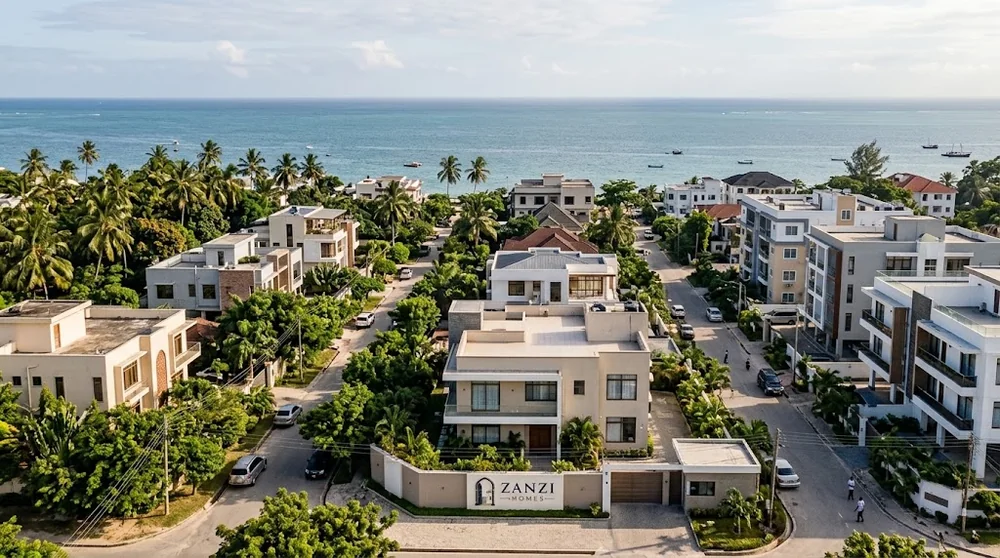
The luxury real estate markets of Zanzibar and Dar es Salaam serve different purposes. Zanzibar’s beach areas are driven largely by tourism and lifestyle buyers, while Dar es Salaam’s premium districts are driven by corporate, diplomatic and resident demand. Choosing a location starts with defining the investment purpose, because a strong holiday-let location may be a weak long-term residential location, and the reverse.
The table below is a qualitative editorial assessment by our team. It contains no verified yields, achieved sale prices or occupancy statistics, and asking prices should never be treated as completed transaction values.
| Area | Typical proposition (editorial assessment) | Infrastructure and access checks | Key risks to verify | Likely buyer or tenant audience |
|---|---|---|---|---|
| Nungwi / Kendwa (north Unguja) | Established holiday-let area with dense hotel activity and swimmable beaches at most tides | Long drive from the airport; water and power backup; road congestion | Competition from hotels, noise, erosion on some stretches, lease status of older plots | Short-stay tourists; resale to lifestyle buyers |
| Matemwe / Kiwengwa (north-east) | Quieter coast with large resorts and reef-facing villas | Village access roads; borehole quality; limited services | Strong tidal range, seaweed seasons, community access paths | Privacy-seeking holiday guests; owner-occupiers |
| Paje / Jambiani (south-east) | Kitesurfing and boutique guesthouse area with an active village economy | Power and water reliability; wastewater near the lagoon | Heavy guesthouse competition, unregistered operations reported by ZIPA, seaweed-farming areas | Active travellers, longer-stay guests |
| Dongwe / Bwejuu / Michamvi (east and peninsula) | Upscale resort stretch with quieter beaches and sunset sites on the peninsula | Distance to services; emergency response time | Shoreline erosion, coastal permits, access through community land | High-end holiday guests; private-villa buyers |
| Fumba (west, near Zanzibar City) | Planned residential developments with easier airport and city access | Developer-provided utilities and management; road links | Dependence on developer governance, service charges, off-plan delivery | Residents, expatriates, longer-term tenants |
| Masaki / Oyster Bay / Mikocheni (Dar es Salaam) | Premium mainland residential districts with corporate and diplomatic demand | Traffic, generator backup, building management quality | Mainland land rules, apartment oversupply in some buildings, TRA tax position | Corporate tenants, embassies, executives |
Stone Town is a separate proposition again. Heritage buildings in a historic conservation setting require distinct checks on conservation rules, permitted alterations and structural condition, and renovation timelines can be longer than for new coastal builds. Mafia Island, Pemba and smaller mainland coastal towns also require their own evidence and should not be assumed equivalent to Unguja’s main tourism corridors.
Infrastructure gaps are real across the islands. Mains water and electricity are less reliable in some eastern and southern villages than in Zanzibar City, and road access to some beachfront plots is a sandy track during the rains. Those factors affect guest reviews, staffing and resale, and they belong in your location decision alongside the view.
Once you know your budget, your intended holding period and whether you want rental income or personal use, a shortlist becomes far easier to evaluate against the risks in this guide.
Get a shortlist of Zanzibar villas matched to your budget and goals
Any shortlist should still pass the same legal, technical and financial checks described above, because a well-matched location does not substitute for verified rights.
Location-selection checklist by investment purpose
- Holiday rental: proven guest demand, tourism licensing route, management capacity, swimmable beach at most tides.
- Personal use: airport and hospital access, privacy, year-round reliability of water and power.
- Long-term residential letting: proximity to employers, schools and services; Fumba and Dar es Salaam usually fit better than remote beaches.
- Capital preservation: remaining lease term, depth of resale audience and documented legal status rather than projected appreciation.
Mistake 5: Buying Without a Resale and Exit Strategy
Exit analysis begins before the deposit, because the documents you accept on day one decide what you can sell later. A luxury villa in Tanzania is typically less liquid than a mainstream home, because the pool of buyers who can afford it, legally acquire it and accept its lease terms is narrow. Marketing periods can be long and depend heavily on location, condition and legal clarity.
The remaining lease term matters most. Imagine two hypothetical villas in the same village, built to the same standard. Villa A sits on a lease with roughly 21 years remaining and a renewal clause subject to authority discretion; Villa B sits on a lease with more than 80 years remaining. An informed buyer, and any lender, will treat Villa A as a shrinking asset whose future depends on an uncertain renewal. We do not assign a numerical discount, because no reliable published dataset exists for that comparison, but the direction of the effect is clear. Every year that passes reduces the remaining term a future buyer can acquire.
Assignment rights come next. On the mainland, as the Ministry of Lands’ August 2026 statement showed, a foreign investor transfers an investment right in compliance with the law rather than selling land. In Zanzibar, transfer of an approved investment and of a registered lease or unit typically involves consents from ZIPA and the land authority, and the incoming buyer may need to satisfy eligibility conditions of their own. Ask your lawyer which consents apply, how long they have historically taken, and whether the lease or development agreement allows refusal. Ground-rent arrears, unpaid service charges or tax obligations can block a transfer entirely.
Management agreements also shape your exit. A villa tied to an operator with long exclusivity, rental pooling or high termination fees may appeal only to buyers who accept that operator. Read termination clauses before buying, not when selling.
Inheritance and succession are document-dependent. Whether a lease or unit can pass to heirs, and through which court process, depends on the instrument, the holding structure and the law applicable to the deceased. Assumptions based on your home country’s rules do not apply automatically.
Taxes and currency complete the picture. Capital gains or transfer taxes may arise on sale under the rules of the relevant jurisdiction, and a buyer funding in a foreign currency is exposed to exchange-rate movement between purchase and sale. Relying on asking-price appreciation is risky: published listing prices are not completed-sale comparables, and independently verified sale prices for luxury properties are genuinely hard to obtain. We always recommend asking a valuer what verified evidence exists rather than accepting an agent’s estimate.
Property purchase, rental authorisation and immigration status are three separate questions. Owning a villa does not by itself authorise tourism letting; Zanzibar’s tourism regulator and the lease use clause govern that. Secondary sources describe residence routes linked to ZIPA-approved property investment, but as of October 2026 any residence permit depends on immigration law and the issuing authority’s current conditions, and should be confirmed separately with qualified counsel. If the legal questions around transfer consents, succession or rental use are specific to your situation, a direct conversation can save time before documents are drafted.
If you are weighing a specific villa and want to understand its lease term, transfer consents or approval status before instructing a lawyer, you can put your questions to our team directly.
Your own independently instructed lawyer should still confirm every legal conclusion in writing, because adviser guidance and formal legal opinion serve different purposes.
Plan three realistic exits from the start: a sale to another qualifying buyer, continued rental operation under a manager, and retention for personal use. A property that works under only one of those scenarios carries concentrated risk.
Coastal Permits, Beach Access and Responsible Investment
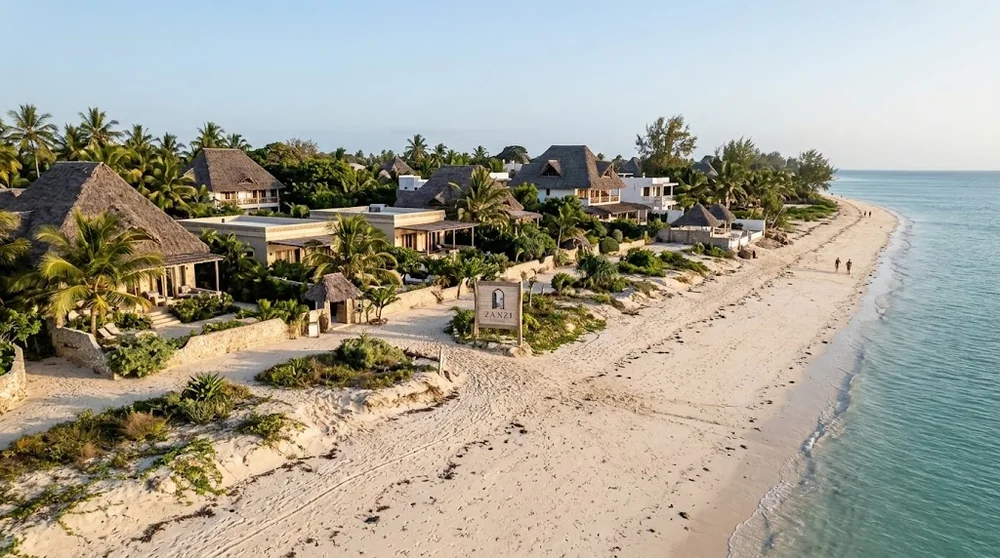
“Beachfront” in an advertisement describes a view and a position; it does not describe legal rights. A beachfront villa’s registered plot boundary may stop well short of the sand, and owning a beachfront property does not normally confer exclusive rights to the beach itself. Your surveyor’s plan, not the photograph, shows what you would hold.
In Zanzibar, environmental oversight sits with ZEMA under the Zanzibar Environmental Management Act, 2015, as amended. As of October 2026, projects are screened and, depending on their classification, may require an Environmental Impact Assessment and an environmental certificate, while smaller works may fall into a lighter category. Not every development needs the same certificate, and we do not cite a single universal shoreline setback distance, because applicable coastal restrictions must be confirmed for the specific location with the relevant authorities.
Key coastal checks before buying:
- Registered boundaries versus physical position: a licensed surveyor should mark where the plot ends relative to the high-water line and vegetation line.
- Environmental status: inspect the ZEMA screening decision or certificate itself; never infer a permit from the fact that construction is ongoing.
- Public and community access: traditional paths to the beach, fishing landing sites and seaweed-farming areas may need to remain open, and blocking them causes legal and social conflict.
- Erosion: look for exposed roots, collapsed walls and recent sandbags along neighbouring plots, and ask how the shoreline has changed over several seasons.
- Seawalls and hard structures: confirm that any wall or groyne was approved; unapproved structures can accelerate erosion next door and create liability.
- Marine ecology: reefs, seagrass and mangroves near the site may limit lighting, boat use, jetties and waste discharge.
- Waste and wastewater: septic overflow onto a beach harms the community, the ecosystem and your guests’ reviews.
- Private amenity versus legal right: a private pool or beach-facing terrace is a feature of your plot; it is not a protected waterfront right.
Responsible investment is also practical investment. From our experience on the island, villas built with respect for village access, local employment and the shoreline tend to face fewer disputes and easier relationships with neighbours, staff and authorities over the long term. That is our team’s observation rather than a measured statistic.
Luxury Property Investment Checklist Before Paying a Deposit
This tanzania real estate investment checklist turns the five mistakes into a sequence. Work through it in order, and do not authorise funds until every step has written evidence.
- Define intended ownership and use. Decide on personal use, holiday letting, long-term letting or a mix, and your holding period. Specialist: property adviser and tax specialist.
- Determine the jurisdiction. Confirm whether the property is in Zanzibar or on the mainland, and therefore which land law, investment authority and tax authority apply.
- Appoint independent specialists. Instruct a jurisdiction-qualified advocate, a licensed surveyor and a technical inspector who are paid by you and independent of the seller and agent.
- Confirm identity and seller authority. Documentary proof: identity documents, company records, board resolutions, powers of attorney or court authority for estates.
- Verify registered rights, restrictions and remaining lease. Documentary proof: official search at the Zanzibar Commission for Lands or mainland registry, full lease or derivative right, encumbrance results.
- Inspect planning, investment and environmental approvals. Documentary proof: ZIPA or TISEZA status, building permit, approved drawings, ZEMA screening or certificate where required.
- Verify site condition and access. Documentary proof: boundary survey, technical inspection report, registered access or easement.
- Model total costs and conservative net income. Documentary proof: lawyer’s cost calculation, utility and maintenance invoices, NOI model with low-occupancy scenario.
- Check payment, completion and refund protections. Documentary proof: draft contract reviewed by your lawyer, milestone schedule, refund and defect clauses, verified payee account.
- Verify resale and rental rights. Documentary proof: assignment and consent clauses, permitted-use clause, tourism licensing route, management agreement termination terms.
Classify each finding using three decision labels:
- Proceed to next check: the official record matches the agreement, the remaining term suits your plan, approvals are current and costs are documented.
- Pause for written evidence: a document is missing, a translation lacks the original, a permit is “in process”, or a cost line has no invoice. Request the evidence in writing and set a deadline.
- Do not pay: the seller is not the registered holder, land descriptions conflict, a charge or dispute is registered, payment is requested to an unrelated beneficiary, a nominee arrangement is proposed, or the developer cannot show land control.
Passing every step of this checklist reduces avoidable risk but does not guarantee any investment outcome, rental income or resale price. Markets, regulations and individual circumstances change after completion.
Frequently Asked Questions About Tanzania Luxury Property Investment
Can foreigners legally buy luxury property in Tanzania?
Foreign investors can acquire certain property interests in Tanzania, but the legal route depends on whether the property is on the mainland or in Zanzibar. Mainland transactions may involve approved investment structures and derivative rights, while Zanzibar has its own leasehold and condominium framework. Independent local counsel should confirm eligibility, permissions and registration before any deposit.
What is the biggest risk of investing in a Zanzibar luxury villa?
One of the most serious risks is paying for a villa without verifying the seller’s registered interest and the buyer’s legal right to acquire it. A ZIPA-related approval or attractive purchase agreement alone is insufficient. Buyers should independently check the land records, lease term, existing charges, development approvals and transfer restrictions before committing funds.
How can I verify ownership before buying property in Tanzania?
Appoint an independent lawyer familiar with the relevant jurisdiction to obtain official land-record evidence and verify the seller’s identity and authority. Compare the registered property description with a certified survey and physical boundaries. Investigate mortgages, disputes, unpaid obligations, land-use restrictions and required consents. The appropriate registry and approval bodies differ between mainland Tanzania and Zanzibar.
What extra costs should I budget for a luxury villa in Zanzibar?
Budget beyond the advertised purchase price for legal checks, registration, applicable taxes, furnishing, insurance, management, staffing, utilities and long-term maintenance. Coastal villas may require additional spending on corrosion prevention, water systems, drainage, pools and backup power. Published closing-cost percentages are estimates, not universal tax rates; obtain a transaction-specific written calculation.
Is it safe to buy an off-plan luxury property in Zanzibar?
An off-plan purchase can be considered only after thorough investigation; it cannot be described as risk-free. Verify the developer’s authority, underlying land rights, investment status, required permits, construction financing and contract protections. Payments should be tied to objectively verifiable obligations, with clear delay, defect and refund provisions. Independent legal and engineering assessments are essential.
Can I rent out or resell a luxury property in Zanzibar?
Rental and resale rights depend on the registered interest, lease conditions, applicable permissions and the terms of any development or management agreement. A buyer should verify commercial-use authorisation, transfer consent requirements, remaining lease duration, taxes and operator restrictions. Purchasing a property does not automatically grant unrestricted tourism operations, residence rights or guaranteed resale liquidity.
A Safer Approach to Luxury Real Estate Investment in Tanzania
The five mistakes share a single cause: accepting a story about a property instead of evidence. Understand the exact legal interest you would hold and under which jurisdiction’s law; verify it independently against official records; test rental claims with a net operating model rather than a gross headline; budget for the real cost of maintaining a coastal home; and confirm before the deposit that the remaining lease, transfer consents and buyer demand support a future exit. A desirable villa is not necessarily a suitable investment, and the difference is found in the documents rather than the view.
From our work between Zanzibar and Dar es Salaam, the buyers who feel most confident years later are those who assembled a property-specific verification file before committing: the full registered instrument, the survey, the approvals, the technical report, a realistic cost budget and their lawyer’s written advice. We always recommend building that file first and making the emotional decision second. If any step produces a “Do not pay” result, walking away is a sound outcome, not a failure.
Legal and regulatory information in this guide reflects our review of published laws, regulations and official guidance as of October 2026, including the Tanzania Land Act, 1999, the Investment and Special Economic Zones Act creating TISEZA, the Zanzibar Land Tenure Act, 1992, the Zanzibar Investment Act, 2023 and the Zanzibar Investment (General) Regulations, 2025. Laws, fees, thresholds and procedures may change, and the registered instrument for each property governs what is actually acquired.
Disclaimer: This article by Zara and the Zanzi Homes team is general educational information and does not constitute legal, tax, immigration or financial advice for any individual situation. All financial figures are hypothetical illustrations, not forecasts or market data. No outcome, return, occupancy, residence status or resale value is promised. Obtain advice from an independent, appropriately qualified advocate, tax specialist, licensed surveyor and technical inspector before entering any property transaction in mainland Tanzania or Zanzibar.
 Real estate in Georgia
 Real estate in Cyprus
 Real estate in the UAE
 Bali Real Estate
 Real estate in Thailand
 Real estate in Spain
 Real estate in Saudi Arabia
 Real estate in Turkey
 +1 555 346 27 41
 hello@zanzi.homes
 Posta Kuu Mizingani Road Zanzibar City, 3310, Zanzibar, Tanzania


 Get catalogue of TOP-7 objects