
 +1 555 346 27 41



Two villas in the same Zanzibar village can carry very different asking prices, and the gap rarely explains itself. One may have a deeper pool terrace, imported fittings and a generator. The other may have the same lease, the same road and the same walk to the sand for far less money. This guide, written by Zara and the Zanzi Homes team, compares luxury and standard property on what you can measure: specification, rights, acquisition costs, annual upkeep and cash after reserves. The aim is to help you compare two specific properties side by side rather than two marketing labels.
Luxury vs standard properties in Zanzibar should be compared by total ownership cost, verified property rights and intended use. Luxury homes may offer better finishes, privacy and services, but bring higher upkeep and capital exposure. Standard homes can suit tighter budgets; neither category automatically delivers stronger net rental returns or easier resale.
What Luxury and Standard Mean in Zanzibar
In this guide, “luxury” and “standard” are editorial comparison groups, not legal or statutory classifications of property in Zanzibar. No Zanzibar authority grants a property stronger rights, faster approvals or a different tax treatment because a developer calls it luxurious. The labels describe specification and services, and they only mean something when they can be checked against drawings, equipment lists and operating records.
A property is not “luxury” simply because it is expensive. Price reflects location, plot size, beach relationship and remaining lease term as much as finishes. For this comparison, we define luxury by measurable features and standard by a sound, approved, functional baseline.
Minimum standards both categories must meet
A standard property in Zanzibar is a lawfully held, approved and structurally sound home with ordinary finishes; “standard” does not mean unsafe, defective or unapproved. Both categories should have verifiable rights, a lawful access route, safe electrical installation, adequate water supply, functioning wastewater treatment and drainage that copes with heavy rain. A property that fails these basics is not a cheaper standard option. It is a property with unresolved problems, whatever the price.
Measurable features that justify the luxury label
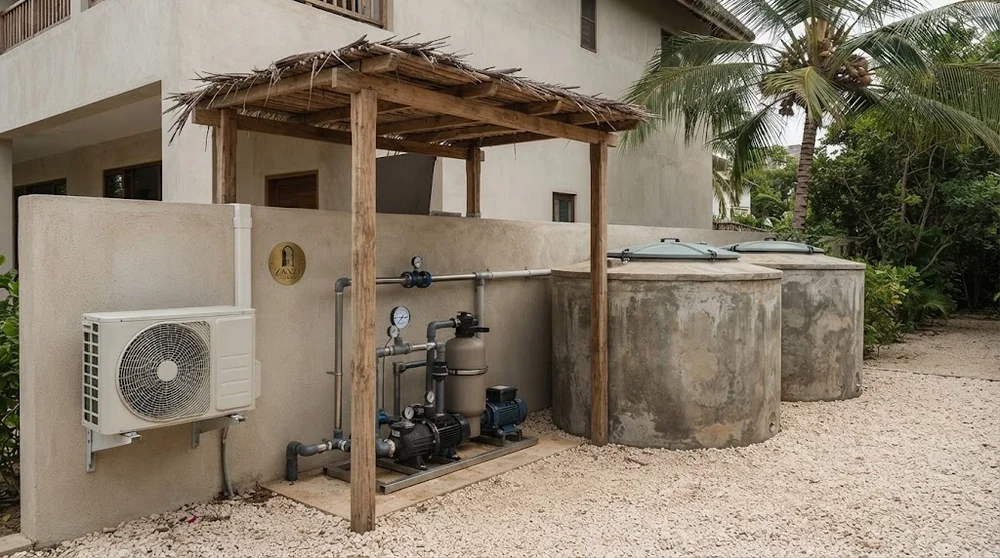
Luxury is defensible when the extra cost buys features you can inspect: more usable internal and outdoor area, higher-grade materials suited to salt air, greater privacy from neighbours and paths, reliable backup power and water, quieter and more efficient cooling, and real services such as housekeeping or on-site security that are documented in a contract. Good maintenance access matters too: pumps, tanks and cooling units that a technician can actually reach are worth more than a hidden plant room nobody can service.
| Feature | Typical standard specification | Typical luxury specification | Evidence to request |
|---|---|---|---|
| Usable area | Compact internal rooms, modest terrace | Larger internal area, covered outdoor living, larger plot | Measured floor plan showing internal and external areas separately |
| Privacy | Shared walls or close neighbours, visible from paths | Screened garden, separation from neighbours and public routes | Site plan, boundary survey, on-site visit at different times of day |
| Workmanship and materials | Local finishes, standard fittings | Corrosion-resistant fittings, higher-grade joinery and waterproofing | Material schedule, warranty terms, independent technical inspection |
| Cooling | Split units in bedrooms, ceiling fans | Cooling in living areas, efficient units, designed ventilation | Equipment models, installation dates, service records |
| Water storage | Basic tank, mains or borehole dependence | Larger storage, filtration, pressure pump with redundancy | Tank capacity, water source documentation, water quality test |
| Backup power | None or small inverter | Generator or solar with battery storage sized for essential loads | Load calculation, equipment specification, maintenance log |
| Services | Owner-arranged cleaning and repairs | Contracted housekeeping, security, pool and garden care | Signed service agreements with itemised fees |
| Maintenance access | Variable; equipment sometimes hard to reach | Dedicated service area with safe access to plant | Photographs and plans of service areas, technician inspection |
If a seller cannot supply most of the evidence in the right-hand column, treat the luxury label as an unverified claim and price the property as if the feature did not exist.

Comparing Zanzibar Property Prices Fairly
A fair Zanzibar property price comparison matches properties on area, beach relationship, type, size, condition, completion status, legal rights and remaining lease term before attributing any price gap to luxury. Without that control, a comparison usually measures the difference between a beachfront plot and an inland one, or between a ten-year-old villa and an off-plan apartment, rather than the value of better finishes.
In practice, the process looks like this: choose two or three properties in the same neighbourhood; record internal floor area and plot size in square metres; note whether each is beachfront, sea-view or near-beach; record completion status, furnishing and visible condition; then obtain each property’s rights documents and the remaining lease term. Only after that do you compare price per square metre and the price of the specific extras. A villa with twenty years left on its lease and an apartment with a fresh, approved term are not like-for-like, even if they look similar on a listing.
Asking prices are not achieved prices
Most published Zanzibar figures are asking prices on listing portals and developer brochures. An asking price records what a seller hopes to receive; it does not record what a buyer actually paid, any discount negotiated, or whether the sale completed at all. Completed-sale evidence is far harder to obtain on the island, and we always recommend asking a seller or agent for documented recent transactions in the same project or street, recognising that such records are often unavailable.
Construction cost is not acquisition cost
Public construction estimates per square metre describe what it may cost to build, not what it costs to buy. Acquisition cost includes land or lease rights, developer margin, approvals, infrastructure, finishing, furniture and transaction costs. A construction estimate should never be used as evidence that a listed villa is overpriced or underpriced.
A source-quality note on our research: during the research for this article we reviewed commercial listing pages showing, for example, a compact two-bedroom residence and a far larger penthouse on the same portal at very different asking prices. Those listings illustrate how size alone drives headline prices; they are not matched evidence of a luxury premium, and we have not repeated their figures because asking prices change and must be rechecked on the day you compare. The evidence reviewed for this article does not establish a reliable island-wide luxury premium for Zanzibar property. Any premium you calculate should come from your own matched shortlist.
Location, Beach Access and Everyday Benefits
Location shapes everyday life more than any finish. Before paying extra for a beachfront plot, separate three terms that listings often blur. A beachfront property has its boundary directly on the beach side with no public road between plot and sand; a sea-view property sees the water but may sit behind other plots; a near-beach property is a short walk from the shore along a lawful access route. None of these terms implies a private beach. In Zanzibar, owners should expect the shoreline to be shared with fishermen, seaweed farmers, neighbours and visitors, and respecting that public access is part of living well in a village.
The same criteria applied to three commonly considered areas:
- Nungwi and Kendwa (north): beaches here are generally less affected by tidal retreat than on the east coast, which suits swimming at most times of day. The trade-offs are busier tourist activity, evening music near some hotels, and road congestion in the high season. Services such as shops and restaurants are relatively dense. Check generator noise from neighbouring hotels and the actual walking route to the sand.
- Paje and Jambiani (south-east): the east coast has a wide tidal range, so the sea can retreat a long way at low tide, exposing the reef flat and seaweed farms. This suits kitesurfing and walking but affects swimming times. Paje has a lively kite scene; Jambiani tends to be quieter and more village-centred. Assess water supply reliability, road condition and distance to the nearest clinic.
- Fumba (south-west, near Zanzibar Town): planned development projects here offer a different profile: closer to the airport and town, more structured infrastructure inside managed communities, and project-level rules on use and services. Beach access varies by project and plot. Check service charges, community rules on rentals, and what infrastructure is complete rather than planned.
- Other coastal villages: areas such as Matemwe or Kiwengwa may suit specific buyers, but judge them only on property-specific evidence of access, tides and utilities rather than general reputation.
Which premium features deliver a practical benefit? Reliable backup power and water storage reduce real disruption, because power and water interruptions still occur in parts of the island. Good drainage protects the building during heavy rains. A beachfront boundary delivers daily access and views, but it also brings salt spray, erosion exposure and higher maintenance. Features such as a larger pool or a designer interior mainly reflect preference: they may raise enjoyment and nightly rates, but they do not solve infrastructure gaps.
We always recommend visiting at high and low tide, at night and on a weekend, and driving the route from the airport yourself. A site benefit that you have not tested in person at different times is an assumption, not a benefit.

Acquisition Costs Beyond the Advertised Price
The advertised price is only the first line of the purchase budget. Commercial guides we reviewed give total acquisition-cost estimates of 4–8% in one case and 6–12% in another. Neither range is an official Zanzibar tariff, and the two estimates are incompatible as universal rules; each depends on the transaction structure, the property and the advisers used. One commercial guide states stamp duty at 5%, which conflicts with the official schedule described below.
The verified position is narrower. The Zanzibar Revenue Authority stamp duty schedule, as checked on 22 October 2026, lists conveyance or transfer at 1%, land lease at 1% and other leases at 0.5%. The date of our check is not the date the schedule took effect; confirm the current version and effective date with the Zanzibar Revenue Authority or a tax adviser. Which rate applies depends on the legal instrument being stamped and the assessment base, so these rates should not be added together automatically. A transfer of an existing lease, the grant of a new lease and an agreement for an off-plan unit may each be treated differently.
| Cost item | Usually responsible | Calculation basis | Evidence to obtain | Applicability |
|---|---|---|---|---|
| Stamp duty | Agreed in contract; often buyer | ZRA schedule rate for the specific instrument (1% conveyance/transfer, 1% land lease, 0.5% other lease, as checked 22 October 2026) on the confirmed base | Written opinion from a Zanzibar tax adviser; ZRA assessment | Every stamped instrument; rate depends on instrument type |
| Registration fees | Usually buyer | Fee set for the registration action | Fee confirmation from the registering authority or lawyer | Where a lease, transfer or unit is registered |
| Independent legal review | Buyer | Fixed fee or hourly quotation | Engagement letter with scope | Every purchase |
| Valuation | Buyer or lender | Valuer’s quotation | Valuation report | Recommended; may be required for approvals or finance |
| Survey and boundary check | Buyer | Surveyor’s quotation | Approved survey plan matched to the site | Standalone plots especially |
| Approvals and permits | Depends on structure | Official fees for the specific application | Fee notices from the relevant authority | Depends on buyer status and project structure |
| Entity set-up | Buyer | Registration fees plus professional fees | Lawyer’s advice on whether an entity is needed | Only where the chosen route requires it |
| Banking and currency conversion | Buyer | Bank charges and exchange spread | Bank fee schedule, written conversion quotation | International transfers |
| VAT | Depends on seller and supply | Whether the price is VAT-inclusive and any exemption applies | Written confirmation in the sale agreement | Verify individually; often relevant to developer sales |
| Furnishing | Buyer unless included | Inventory and supplier quotations | Signed inventory listing included items | Unfurnished or partly furnished properties |
| Initial repairs | Buyer unless negotiated | Contractor quotations after inspection | Technical inspection report | Resale properties especially |
Project-specific incentives, such as benefits linked to investment approval, can change the cost picture, but they apply to defined projects and investors, not to every buyer. Ask for the incentive in writing, identify the approving body, and have your lawyer confirm that it transfers to you. The only reliable acquisition budget is an itemised list of quotations and confirmed tax treatment for the exact transaction you intend to sign.
Annual Ownership Costs and Replacement Reserves
Annual ownership costs for a Zanzibar property fall into three separate groups: fixed costs paid whether or not the property earns income, variable costs that rise and fall with bookings, and replacement reserves set aside for equipment and finishes that wear out. Mixing these groups is how budgets go wrong, because a quiet season cuts revenue and some variable costs but leaves the fixed costs and the salt air untouched.
- Fixed costs: annual land rent under the lease, any applicable property charges, insurance, permanent staff, security, base utilities, pool and garden care, internet and routine maintenance contracts. The Zanzibar Revenue Authority states that annual land rent follows the lease agreement (as checked in October 2026), so read the figure and review terms in your own lease rather than relying on an island-wide estimate.
- Variable costs: booking platform commissions, management fees charged as a percentage of revenue, guest cleaning and laundry, consumables, extra electricity for cooling during occupied nights, and applicable taxes on rental income or guest stays.
- Replacement reserves: cash set aside for cooling units, pumps, water heaters, generator overhauls, solar batteries, pool equipment, soft furnishings, repainting and roof or waterproofing work. Coastal exposure shortens the life of metal fittings and electronics, and some parts must be imported, which adds cost and delay.
- Wastewater and water: septic or treatment system emptying, borehole or tank maintenance and water testing belong in the fixed budget even when the house is empty.
Avoiding double counting
A mistake we see foreign buyers make: adding a management fee and a service charge to the budget when both already cover the same pool cleaning, gardening or security. Ask for the service-charge breakdown and the management agreement, then list each task once with the party responsible. Equally, a contractor quote that “includes” maintenance may exclude parts. Every annual cost line should name who pays, who performs the work and which document sets the price.
Why larger villas cost more even when empty
A large private villa usually needs more fixed spending during vacancy than a compact unit: a bigger pool still needs chemicals, a larger garden still needs watering, and more equipment still needs servicing and security. That fixed base is why the luxury option can look strong in peak months and weak across a full year. We do not use a percentage-of-value maintenance rule here, because we have found no verified local benchmark; use itemised quotations and, where available, at least one or two years of actual operating accounts.
Luxury Versus Standard: A Worked Cost Comparison
The following example is an explicitly hypothetical teaching model, not a real client transaction, a market average, an available listing or a forecast. It compares two two-bedroom villas in the same area with equivalent verified rights, the same remaining lease duration and the same beach access, so that only specification, cost and income assumptions differ.
The formulas used are:
- Variable operating costs = 30% × annual gross bookings
- Operating cash after reserves = gross bookings − variable costs − fixed operating costs − replacement reserves
- Cash after reserves as a percentage of initial cost = operating cash after reserves ÷ all-in initial cost
- Gross yield = annual gross bookings ÷ all-in initial cost
| Line item | Standard villa: base | Luxury villa: base | Standard villa: bookings −25% | Luxury villa: bookings −25% |
|---|---|---|---|---|
| All-in initial cost | 220,000 | 400,000 | 220,000 | 400,000 |
| Annual gross bookings | 30,000 | 50,000 | 22,500 | 37,500 |
| Variable operating costs (30% of bookings) | 9,000 | 15,000 | 6,750 | 11,250 |
| Fixed operating costs | 7,000 | 14,000 | 7,000 | 14,000 |
| Replacement reserves | 3,000 | 5,000 | 3,000 | 5,000 |
| Operating cash after reserves | 11,000 | 16,000 | 5,750 | 7,250 |
| Cash after reserves ÷ initial cost | 5.0% | 4.0% | 2.6% | 1.8% |
| Gross yield (bookings ÷ initial cost) | 13.6% | 12.5% | 10.2% | 9.4% |
The arithmetic step by step
Standard villa, base case: 30,000 − 9,000 − 7,000 − 3,000 = USD 11,000, and 11,000 ÷ 220,000 = 5.0%. Luxury villa, base case: 50,000 − 15,000 − 14,000 − 5,000 = USD 16,000, and 16,000 ÷ 400,000 = 4.0%.
In the downside case, bookings fall by 25%, variable costs fall in proportion, and fixed costs and reserves stay the same. Standard villa: 22,500 − 6,750 − 7,000 − 3,000 = USD 5,750. Luxury villa: 37,500 − 11,250 − 14,000 − 5,000 = USD 7,250.
What the model shows
In this hypothetical case, the luxury villa produces more cash in absolute terms but a lower percentage on the capital invested. The extra USD 180,000 of initial cost adds USD 5,000 a year of cash after reserves in the base case (about 2.8% on the additional capital) and only USD 1,500 in the downside case (about 0.8%). Because the luxury villa carries higher fixed costs and reserves, a fall in bookings reduces its cash after reserves by a larger share: about 55% for the luxury villa against about 48% for the standard villa in this model. Change the assumptions and the ranking can reverse; that is precisely why the model must be rebuilt with real figures.
What is excluded
The model explicitly excludes financing costs, income tax, disposal costs on sale and any capital appreciation or depreciation. A replacement reserve is a cash allocation set aside for future replacements, and it is not necessarily a current accounting expense for tax purposes. After-tax results depend on your residence, the ownership structure and the applicable Zanzibar and home-country rules, so they require advice from a suitably qualified tax adviser. None of these figures is a guaranteed return, and the model is a single-year snapshot, not a five-year projection.
To use the model, replace each line with evidence: the agreed price plus itemised acquisition costs from Table 2; booking income from documented rental statements for comparable properties; variable costs from the management agreement and platform terms; fixed costs from signed quotations and the lease; and reserves from equipment ages and technician estimates.
Rental Benefits, Owner Use and Resale
A luxury villa in Zanzibar may command a higher nightly rate, but a higher rate can coexist with lower occupancy, higher running costs and a lower return on invested capital. Three measures keep the comparison honest. Gross yield is annual gross bookings divided by the all-in initial cost, before any operating costs. Operating cash after reserves is gross bookings minus variable costs, fixed costs and replacement reserves. After-tax cash flow is the cash remaining once applicable taxes on rental income and the owner’s own tax position have been taken into account, which needs professional tax input. Only the last two measures approach spendable income.
Owner use has a real cost. If you plan to spend six weeks a year in the villa, model those dates as nights unavailable for booking, and preferably as high-season nights if that is when you will travel. Reduce the booking assumption accordingly; do not then add the value of your stay as income, because that would count the same nights twice. Allow for downtime too: repairs after the rains, equipment failures awaiting imported parts, and the low season.
Ask for achieved rental statements, not advertised rates. A listing showing a nightly price says nothing about how many nights sold or what commissions were deducted. Official tourism statistics from the Office of the Chief Government Statistician in Zanzibar can show visitor arrivals and seasonality, but island-wide tourist arrival figures cannot establish the occupancy of any individual villa. Competition matters as well: new projects add supply in popular areas.
Check the rules before relying on rental income. Management agreements may require a particular operator, set minimum terms or restrict owner stays; project rules may limit short-term letting; and permitted rental use depends on the property’s approvals. On resale, the buyer pool and price depend heavily on the remaining lease term, on whether a transfer requires consent or approval, and on evidence that similar units have actually resold. A resale market cannot be assumed from asking prices alone. We cannot promise liquidity or appreciation for either category, and no honest adviser can.
If you would like a second opinion on the rental statements or management terms of a specific property before you commit, our team can review the documents with you and explain which points need a lawyer or tax adviser. Send the property details, the statements you have received and your planned owner-use dates, and we will tell you plainly what is missing.
Property Rights and Checks Before a Deposit
A luxury label changes neither a buyer’s legal eligibility nor the approvals a Zanzibar property transaction requires. The same legal framework applies to a modest apartment and a large beachfront villa. In Zanzibar, land is held under the island’s own land laws, which differ from the rules on mainland Tanzania; foreign buyers typically acquire leasehold interests through an approved route rather than outright ownership of land. The precise route for you must be determined by an independent Zanzibar property lawyer.
The key instruments are the Land Tenure Act 1992, the Condominium Act 2010, the Zanzibar Investment Act 2023 and the Zanzibar Investment General Regulations 2025. The Zanzibar Investment General Regulations 2025 were published in the Government Gazette on 20 June 2025. The Commission for Lands administers land matters, and ZIPA, the Zanzibar Investment Promotion Authority, handles investment approvals. We have not reproduced specific clauses on eligibility, lease duration or renewal here, because their current application to a given buyer and property must be verified by a lawyer at the time of your transaction (position as of October 2026). A marketed 99-year term is not automatically granted to every buyer, and lease renewal is not guaranteed.
Condominium unit or standalone lease
An apartment or villa within an approved condominium scheme is held as a unit within that scheme, with shared common property, a management body and service charges. A standalone villa on its own plot may instead involve an investment lease linked to an approved project or investor. These routes can involve different documents, approvals, costs and transfer conditions. Ask your lawyer which applies before comparing prices, because the route affects what you are actually buying.
Verification sequence
In practice, the process looks like this:
- Engage an independent Zanzibar property lawyer who does not act for the seller or developer.
- Confirm the seller’s identity and authority to sell, including company resolutions or powers of attorney where relevant.
- Obtain the registered rights documents and have the lawyer search for encumbrances, disputes and outstanding charges.
- Match the approved survey plan to the physical boundaries and confirm lawful access from a public road.
- Record the remaining lease term, rent, review terms and any conditions on transfer, use or development.
- Check for arrears of land rent, utilities and service charges, and obtain written confirmation of clearance.
- Confirm the investment, project or condominium approvals relevant to your route, and whether the property may lawfully be rented to guests.
- Review building permits, completion documentation and any environmental approvals relevant to the site, especially for coastal plots.
- Obtain written tax treatment for the instrument, including stamp duty and VAT, before signing.
- Confirm that the payment recipient matches the seller or an authorised escrow arrangement named in the agreement.
Stop conditions
Pause before paying anything if records are missing, if the survey does not match the site, if the remaining lease term is shorter than you were told, if approvals are described as “in progress” without written evidence, or if you are asked to pay a person or account that does not match the documents. Before you pay a deposit, confirm the approval status. Do not use nominee arrangements to get around eligibility rules, and do not assume that forming a company is always required; it depends on the route.
Separate statutory processing stages from total completion time. A defined stage within an approval process tells you nothing about the time needed for due diligence, document gathering, payments, registration and handover, which together usually take considerably longer.
If any step in this sequence is unclear for the property you are considering, a short conversation can save an expensive mistake. Our team can explain the stages, prepare questions for your lawyer and help you assemble the documents needed for an independent review.
Which Zanzibar Property Fits Your Budget?
The right category depends on how you will use the property. Match the use first, then test the budget against the full total cost of ownership, which is the purchase price plus acquisition costs, annual running costs and replacement reserves over the period you plan to hold the property.
| Intended use | Main priorities | Budget trade-off | Evidence required |
|---|---|---|---|
| Full-time living | Reliable power and water, road access, healthcare, schools, residence route | Infrastructure reliability often matters more than premium finishes | Utility history, travel times, legal advice on residence and rights |
| Occasional holidays | Security when absent, low fixed costs, simple maintenance | A standard home with good management may cost less to keep than a large villa | Caretaking quotations, security arrangements, insurance terms |
| Remote ownership | Trustworthy management, transparent accounts, maintenance access | Higher management fees may be justified by reporting quality | Management agreement, sample monthly reports, references |
| Rental-led purchase | Lawful rental use, achieved bookings, cash after reserves | Luxury may raise rates but lower percentage return on capital | Achieved rental statements, permitted-use approvals, cost quotations |
Our assessment, offered as team opinion rather than verified fact: buyers rarely regret paying for reliable water, power and drainage, but they sometimes regret paying for size and finishes they do not use. The sound way to choose is to compare the verified rights, total cost of ownership and usable benefits of two specific properties, one standard and one luxury, before deciding on a category.
If you would like that comparison prepared, send us your budget, intended use, preferred area and planned owner-use dates, and we will build an itemised side-by-side of a standard and a luxury shortlist, marking which figures are quoted and which still need verification.
Frequently Asked Questions
What makes a property in Zanzibar luxury rather than standard?
For this comparison, luxury describes measurable features such as higher specifications, greater privacy, reliable backup systems and more extensive services. It is not a legal ownership category. Compare the written specification, completed workmanship and operating arrangements, because a luxury label alone does not establish better construction, stronger property rights or better value for the buyer.
How much more does a luxury property in Zanzibar cost?
There is no reliable island-wide luxury premium in the evidence reviewed for this guide. Asking prices combine different locations, sizes, property types and legal arrangements. Compare similar properties in the same area, including usable floor area, condition, beach access, remaining lease term and included services, before calculating the extra purchase and ownership cost.
What ongoing costs should I budget for a Zanzibar villa?
Budget for the land rent specified in the lease, applicable property charges, insurance, utilities, maintenance, security and any management or service fees. Pools, gardens, backup systems and coastal exposure can increase spending. Keep replacement reserves separate from routine bills, and check whether service charges already cover items listed elsewhere in your budget.
Can foreigners buy both luxury and standard properties in Zanzibar?
A property’s luxury or standard label does not determine a foreign buyer’s eligibility. The relevant questions concern the registered rights, approved project structure, buyer status and required permissions. An approved condominium unit and a standalone investment lease can involve different procedures. Obtain independent Zanzibar legal advice on the specific property before signing or paying anything.
Does a luxury villa in Zanzibar produce better rental returns?
A luxury villa may achieve a higher nightly rate while producing a lower return on total invested capital. Purchase cost, occupied nights, management, utilities, staffing and replacement reserves all affect the result. Compare documented rental performance and conservative scenarios, allowing for owner use and downtime, rather than treating advertised rates or gross yields as spendable income.
Is beachfront property worth the extra cost in Zanzibar?
Beachfront property can offer direct access, views and personal enjoyment, but its value depends on the specific site and your priorities. Check lawful access, tidal conditions, erosion exposure, drainage, salt-related maintenance and insurance terms. Compare the additional annual cost with a nearby property offering similar practical access before deciding whether the premium is justified.
Our View on Choosing Between Luxury and Standard
From what we see on the island, the most useful question is not “luxury or standard?” but “what exactly does this extra money buy, and can I prove it?” A luxury villa earns its premium when the specification, services and site benefits are documented and match how you will live in or let the property. A standard home earns its place when it is lawful, sound and well located, and when its lower fixed costs leave room for reserves.
Whichever category you lean towards, the order of work stays the same: verify the rights and remaining lease term, itemise acquisition costs with confirmed tax treatment, separate fixed costs, variable costs and reserves, and test rental assumptions against achieved statements and a downside case. We always recommend making those comparisons on two real properties, with an independent lawyer and tax adviser involved, before any deposit leaves your account.
Disclaimer: This article provides general educational information as of October 2026 and is not legal, tax, financial or technical advice. The worked example is hypothetical. Property rights, approvals, taxes and building condition must be assessed for each specific property by an independent Zanzibar property lawyer, a qualified tax adviser and a suitable technical specialist.
 Real estate in Georgia
 Real estate in Cyprus
 Real estate in the UAE
 Bali Real Estate
 Real estate in Thailand
 Real estate in Spain
 Real estate in Saudi Arabia
 Real estate in Turkey
 +1 555 346 27 41
 hello@zanzi.homes
 Posta Kuu Mizingani Road Zanzibar City, 3310, Zanzibar, Tanzania


 Get catalogue of TOP-7 objects